Introduction
Machine learning has become one of the trending technologies due to its hidden potential for limitless transformations across various industries.
It is used in many disciplines such as self-driving automobiles (Tesla, Apple Cars, Google’s self-driving cars), e-commerce websites and apps (Amazon, Flipkart, Myntra), face detection (smart homes), entertainment platforms (OTT platforms such as Netflix, HBO, and Amazon Prime Video), and several other applications where machine learning is leveraged by both customers and businesses.
Supervised machine learning can be considered the second step toward machine learning.
What is Supervised Machine Learning?
Supervised learning is the most fundamental and commonly used subcategory of machine learning, and there is no doubt that most practitioners begin their machine learning journey with supervised learning. In brief, it is often the first step toward machine learning. In supervised learning, labeled data (datasets containing features and labels) are used, and supervised machine learning algorithms predict the classification of new, unlabeled data.
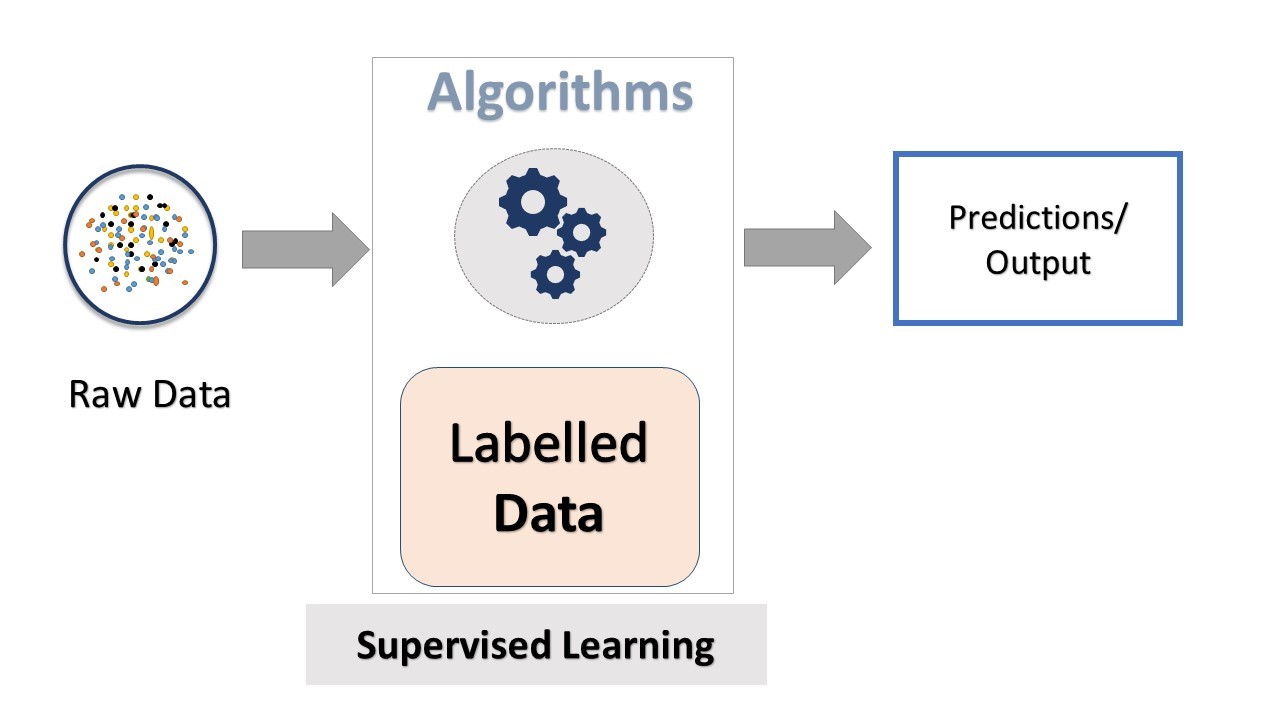
Working of Supervised Machine Learning
While training a supervised machine learning algorithm, the system encounters a massive amount of data to predict specific outputs for given input values.
In simple terms, it tries to identify patterns or relationships between input and output values.
After training, the trained machine learning algorithm is validated using a testing dataset, which verifies the efficiency of the results and measures the accuracy of the algorithm.
Steps Involved in Supervised Machine Learning
- Step 1: Determining the data types of the datasets.
- Step 2: Collecting the labeled datasets.
- Step 3: Splitting the collected dataset into training, testing, and validation datasets.
- Step 4: Determining the input variables for training datasets. These input variables should contain sufficient information so that the built model can accurately predict the target attributes or output.
- Step 5: Selecting a suitable machine learning prediction model or algorithm such as linear regression, polynomial regression, or support vector machines.
- Step 6: Executing the machine learning model on training datasets with validation sets used as control parameters.
- Step 7: Introducing evaluation metrics, which indicate the accuracy of the machine learning model by comparing predicted outputs with the testing dataset. If the output values are predicted correctly, the model is considered accurate.
Types of Supervised Machine Learning
Types of supervised learning algorithms:

Regression Algorithms
Regression algorithms are predictive statistical models in which the model attempts to identify the relationship between dependent and independent variables.
In regression algorithms, the target variable (estimated value) is numeric, such as sales or income of an entity, house prices, or student test scores.
Types of Regression Analysis
- Linear Regression
- Polynomial Regression
- Multiple Regression
- Lasso Regression
- Ridge Regression
- Elastic-Net Regression
Classification Algorithms
Classification algorithms are supervised machine learning techniques that classify datasets into various classes based on specific characteristics. Essentially, these algorithms identify the class to which a particular instance belongs. In classification algorithms, the target variable is categorical. These techniques are commonly used in fraud detection, face detection, and sentiment analysis.
Some of the well-known and commonly used classification algorithms are listed below:
- Logistic Regression
- Naïve Bayes
- Linear Discriminant Analysis
There are several other algorithms as well. These algorithms are often listed under classification algorithms, but in some cases, they are also used across both subcategories. These algorithms include:
- Decision Tree Algorithms
- Support Vector Machine
- K-Nearest Neighbors
Advantages of Supervised Machine Learning
- Unlike unsupervised machine learning, supervised machine learning models predict output values based on previously known values.
- In supervised learning, objects can be classified accurately.
- It helps solve various real-life problems such as fraud detection and spam detection.
Disadvantages of Supervised Machine Learning
- Unlike other types of machine learning, supervised learning is not suitable for handling highly complex tasks.
- Supervised machine learning techniques may perform poorly when applied to testing datasets that differ significantly from the training data.
- Compared to semi-supervised learning, supervised learning requires large training datasets and consumes significant computational time.
- Supervised learning requires sufficient prior knowledge about the classes of objects.
Applications of Supervised Machine Learning
- Spam Detection
- Sales Forecasting
- House Price Prediction
- Handwriting Detection
- Speech Recognition
- Object Recognition
- Bioinformatics
- Fraud Detection
Powered by Froala Editor