Introduction
The derivative market is a segment of the financial market where various derivative instruments are traded. Derivatives are financial instruments such as futures or forward contracts, options, and swaps. A derivative’s value is derived from an underlying financial asset or a group of assets (such as market indices like S&P 500, SENSEX, and NIFTY 50). The underlying assets may include stocks, market indices, bonds, and currencies. These instruments are also known as deferred delivery or deferred payment instruments (involving short and long positions).
Market Participants
There are mainly three participants in the derivative market:
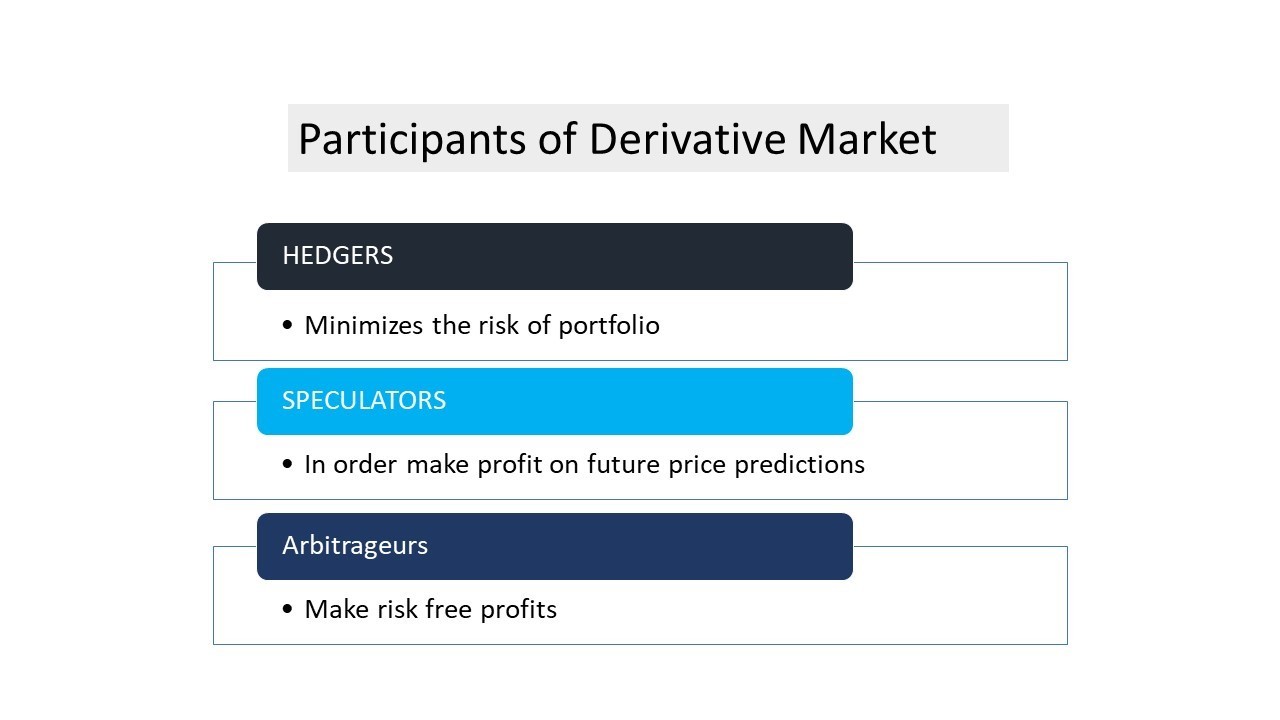 Participants of Derivative Market
- Hedgers – These are participants who buy or sell in the market to reduce the risk of their portfolios. They do not aim for high short-term returns but instead seek to transfer or minimize risk using derivatives.
- Speculators – These participants enter the market to earn profits by buying or selling derivatives. They speculate on future price movements and trade futures and options contracts, accepting both the potential for high gains and significant losses.
- Arbitrageurs – These participants attempt to earn risk-free profits through simultaneous buying and selling of assets in different markets. They exploit price differences of the same securities across markets.
Market Structure
There are two types of markets based on transaction mechanisms:
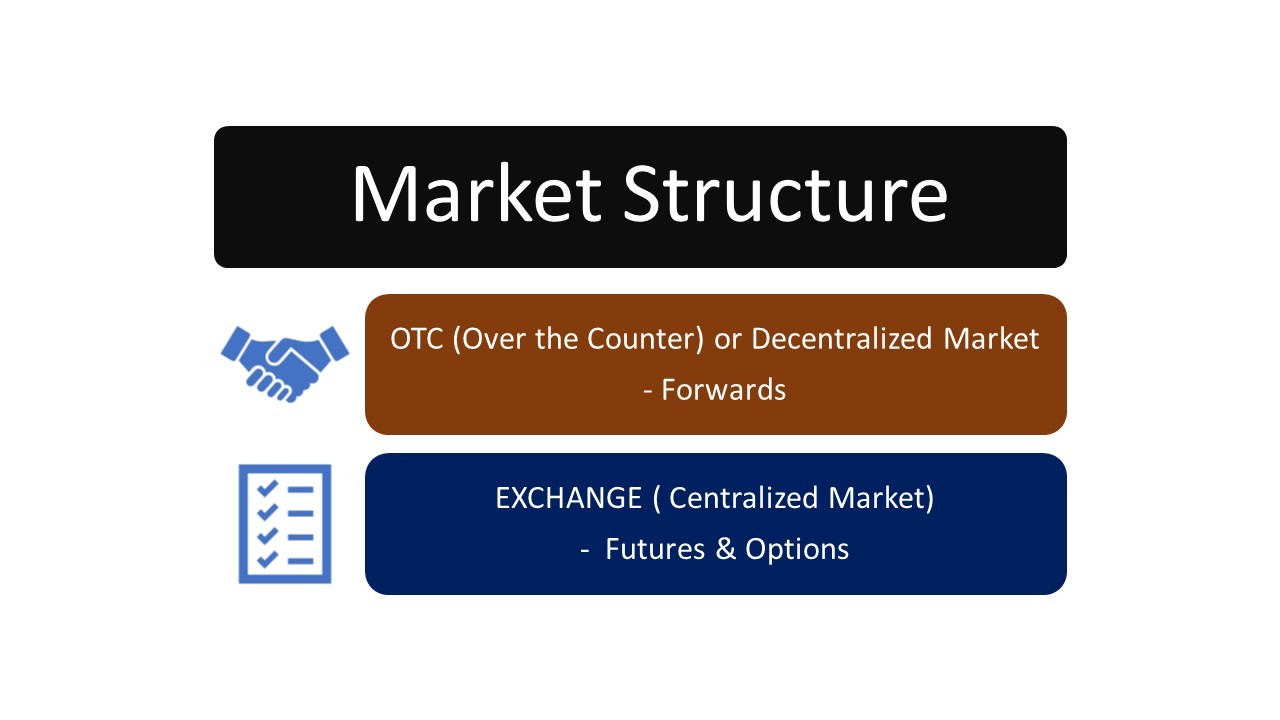
- OTC (Over the Counter) – A market where transactions take place directly between two parties without a broker or third party. It is also known as a decentralized market, as there is no central authority to ensure transparency and standardization. Such deals rely on mutual trust. Example - Forwards
- Exchange Market – A market where transactions occur through an exchange or intermediary. It is also known as a centralized market. While direct trading is possible, it can be risky if counterparties do not know each other, increasing the chances of default or fraud. Exchanges reduce this risk. Examples – Futures & Options
Types of Derivatives
There are four types of derivatives:
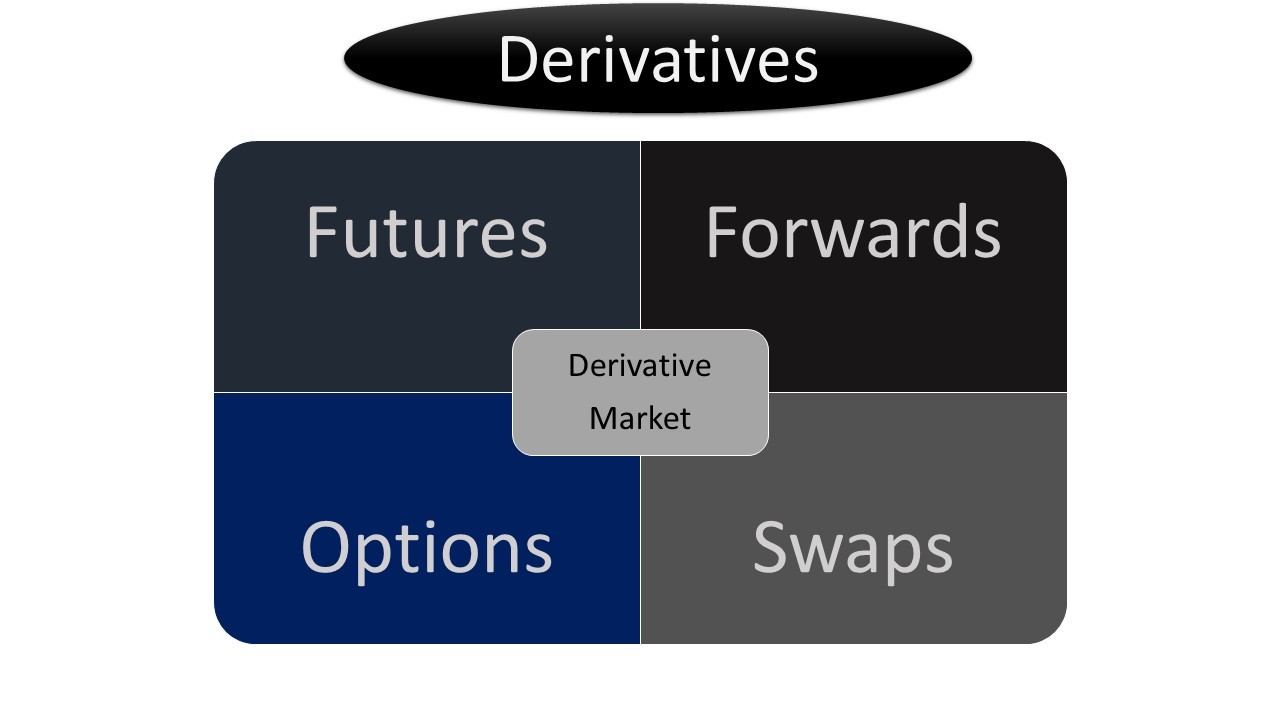
Forward Contracts
A forward contract is the simplest form of a derivative, in which two parties agree to buy or sell an underlying asset at a predetermined price on a specified future date. These contracts are usually traded in OTC (Over the Counter) markets. There are mainly four types of forward contracts:
- Closed Outright Forward: These are the most common types of forward contracts, also known as standard forward contracts. In this type, both counterparties agree to exchange funds or securities at a specified date and price in the future.
- Flexible Forward: In a flexible forward contract, counterparties agree to exchange funds on or before a specified settlement date at a fixed price.
- Long-dated Forward: These contracts are similar to standard forwards but have a longer maturity period, typically exceeding one year.
- Non-deliverable Forward: In these contracts, instead of delivering the underlying asset physically, the counterparties settle the difference between the spot rate and the contract rate. These are commonly used in currencies and certain commodities.
Future Contracts
A futures contract is a standardized legal agreement in which two parties agree to buy or sell an asset at a predetermined future date and price through an exchange. These contracts are traded on exchanges.
Futures contracts can be classified into several types, including:
- Stock Futures: These involve agreements to buy or sell stocks through futures contracts traded on stock exchanges. Participants can benefit from leverage. For example, if a trader enters into a futures contract worth 800,000 USD with an initial margin of 10%, they only need to invest 80,000 USD.
- Index Futures: These are contracts based on market indices such as S&P 500, SENSEX, or NIFTY 50, used for speculation or hedging.
- Commodity Futures: These contracts are used to speculate on or hedge against price movements in commodities.
- Currency Futures: These are standardized contracts traded on exchanges where counterparties agree to exchange currencies at a predetermined price and future date.
- Interest-rate Futures: These contracts are based on fixed-income securities such as bonds and money market instruments.
Options – Options are derivative instruments based on underlying assets such as stocks. They give the buyer the right, but not the obligation, to buy or sell an asset at a specified price (strike price) on or before a certain date. Options are of two types: calls and puts.
- Call Option: A call option gives the buyer the right, but not the obligation, to buy the underlying asset at a specified strike price. It is typically used when an investor expects the price of the asset to rise.
- Put Option: A put option gives the buyer the right, but not the obligation, to sell the underlying asset at a specified strike price. It is typically used when an investor expects the price of the asset to fall.
Swaps - A derivative contract in which two counterparties exchange cash flows or financial obligations based on underlying instruments.
Powered by Froala Editor